How to Build an Agentic Terminal Workflow with GitHub Copilot CLI and MCP Servers
This article details how to transform your terminal into a powerful, context-aware “agent” by integrating GitHub Copilot CLI with MCP (Model Context Protocol) servers. It moves beyond basic autocomplete to enable autonomous AI interactions that understand your project, query live data, and chain tool calls. By wiring these systems together, developers can build a terminal experience that adapts to their specific workflow needs.
Here are the key takeaways:
- Elevated AI Assistance: Move beyond simple command autocomplete to an AI that understands your project context and executes complex tasks.
- Model Context Protocol (MCP): This open standard allows AI models to connect to external tools (like Git, Docker) and real-time data sources.
- Agentic Terminal Workflow: The synergy between Copilot CLI and MCP servers creates an “agentic” terminal capable of autonomous tool calling and contextual problem-solving.
Gemini Can Now Generate Files Directly in the Chat
Google’s Gemini AI has significantly boosted its capabilities by introducing direct file generation within its chat interface. This new feature allows users to create various file types without needing to export or switch applications, streamlining workflows and enhancing productivity. It’s a major step towards making AI assistants even more integrated into our daily tasks.
- Gemini can now generate files directly from the chat conversation.
- This feature simplifies the user experience by eliminating the need to leave the AI interface.
- It promises to boost productivity by integrating content creation more seamlessly.
Subagents Have Arrived in Gemini CLI
Gemini CLI has introduced subagents, specialized expert agents designed to handle complex, repetitive, or high-volume tasks. These subagents operate in isolation with their own context windows and tools, allowing the main Gemini session to remain fast, lean, and focused on the big picture. By delegating specific sub-tasks, they prevent context pollution and significantly speed up overall workflow, consolidating intricate executions into single responses. This empowers users to manage complex projects more efficiently and keep their primary agent focused on strategic orchestration.
- Context Isolation: Subagents operate with separate context windows and custom instructions, preventing the main session from getting cluttered.
- Customization & Parallelism: Users can define custom subagents for specific workflows, enforcing standards or roles, and even run multiple subagents in parallel for faster task completion.
- Built-in Experts: Gemini CLI ships with useful pre-built subagents like
generalist,cli_help, andcodebase_investigatorfor immediate delegation.
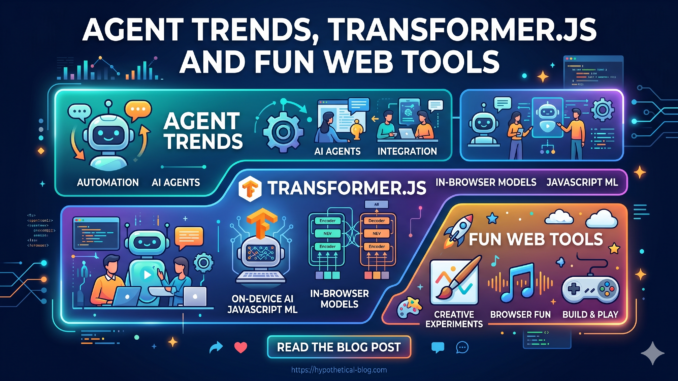
Run Transformers in Your Browser with Transformers.js
Hugging Face’s Transformers.js library brings state-of-the-art machine learning directly into your web browser, enabling powerful AI inference without the need for a server. This innovative tool allows developers to execute complex deep learning tasks client-side, boosting privacy and reducing latency for web applications. It offers a familiar API, functionally equivalent to the Python transformers library.
Here are some key takeaways:
* Server-less AI: Perform advanced machine learning tasks directly in the browser, eliminating backend server needs.
* Versatile Model Support: Access models for a broad range of tasks including NLP, Computer Vision, Audio, and Multimodal applications.
* Familiar Python-like API: Utilize a convenient pipeline API that mirrors the Hugging Face Python library for easy adoption.
Announcing Babylon.js 9.0
Babylon.js 9.0 has arrived, marking a monumental leap forward in web rendering engines. This update is their biggest and most feature-rich release yet, empowering developers to create richer, more immersive web experiences with groundbreaking new capabilities and performance improvements. It pushes the boundaries of what’s possible on the web, celebrating an incredible year of innovation.
Key takeaways from this release include:
- Clustered Lighting: Dramatically speeds up lighting calculations for scenes with hundreds or thousands of lights, ensuring buttery smooth frame rates.
- Node Particle Editor: A powerful new visual tool enabling the creation of complex particle systems through an intuitive non-destructive node graph.
- Frame Graph System: Offers complete, fine-grained control over the rendering pipeline, leading to substantial GPU memory savings and unprecedented rendering flexibility.
Signals, the Push-Pull Based Algorithm
This insightful article demystifies the internal mechanics of Signals, the core reactivity primitive powering modern front-end frameworks like Solid and Vue. It breaks down how Signals enable automatic, spreadsheet-like updates where derived values instantly react to changes in their dependencies, all driven by a fascinating push-pull based algorithm.
Here are the key takeaways:
* Signals are push-based: When a signal’s value changes, it pushes notifications to its subscribers, eagerly propagating the change downstream.
* Computeds are pull-based: These derived values are lazy; they are invalidated when dependencies change but only pull for a re-evaluation when their value is actually read.
* Automatic Dependency Tracking: Computeds magically track which signals they depend on during execution, subscribing to updates without manual configuration.
How VS Code Builds with AI
VS Code has dramatically transformed its development workflow by deeply integrating AI agents, allowing them to shift from monthly to weekly releases while maintaining high standards of rigor and quality. This profound change isn’t just about faster coding, but about leveraging AI across every facet of the team’s work, including issue triage, code reviews, release notes generation, and validation. The article highlights how agents empower the team to work more efficiently, deliver improvements faster, and adapt to an accelerated cadence.
- Parallelize Work: Engineers now kick off multiple agent sessions simultaneously, enabling parallel progress on bugs, features, and triage.
- Streamline Workflows: Traditional intermediate steps like extensive meeting notes and specs are being skipped, moving directly from discussions to agent-driven code.
- Automate Overhead: Agents now handle tasks that scale with velocity, such as commit summarization, issue triage, and generating release notes, freeing up human engineers for more complex problems.
Chiptune.app: Your Browser-Based Chip Music Experience
Chiptune.app introduces itself as “Chip Player JS,” a web application that brings the distinctive sounds of chiptune music directly to your browser. Built entirely with JavaScript, it promises an accessible and convenient platform for engaging with this retro music genre. This tool aims to remove barriers to entry, allowing users to dive into chiptune without any software installations or complex setups.
- Instant Access: Enjoy chiptune music directly in your web browser, no downloads needed.
- JavaScript-Powered: Leverages modern web technologies for broad compatibility and performance.
- Dedicated to Chiptune: A focused platform for fans and potential creators of 8-bit style audio.
Leave a Reply