
Winning hackathons isn’t about building production-grade enterprise software from scratch; it’s about velocity of validation. The faster you can turn a concept into a tangible, testable prototype, the better your demo will be.
Here are 10 essential tools—spanning generative UI, turnkey backend templates, AI agent frameworks, and battle-tested data layers—to eliminate friction and bring your hackathon concept to life at lightning speed.
1. Google Stitch
Best for: Going from idea to interactive UI mockup in under 5 minutes
Staring at a blank Figma canvas when the clock is ticking is paralyzing. Google Stitch flips the UI workflow on its head: instead of designing screen-by-screen, you prompt it. Stitch generates high-fidelity, polished web and mobile layouts directly from conversational descriptions or reference screenshots.
You can visually tweak components, branch user flows, and export clean HTML/CSS or hand off directly to Figma. It lets non-designers build professional-looking interfaces while freeing engineers to focus on backend logic.
2. Full-Stack FastAPI Template
Best for: Instant production-ready web architecture with auth and database built in
Why spend your first six hours wiring up JWT tokens, password resets, and Docker files? Created by Tiangolo and the FastAPI community, this template provides a rock-solid foundation:
- Backend: FastAPI with SQLModel/PostgreSQL and Alembic migrations.
- Frontend: Modern React with Vite, TanStack Query, and Tailwind/Chakra UI.
- DevOps: Docker Compose setup ready to run locally with one command (
docker compose up).
If your hackathon app needs user accounts, role-based dashboards, or secure API endpoints, cloning this repository puts you at the 60% mark on minute one.
3. Google Antigravity CLI
Best for: Terminal-native AI coding assistance and rapid scaffolding
When moving at hackathon speed, context-switching between your code editor, documentation, and browser tabs wastes precious minutes. Antigravity CLI brings agentic AI capabilities straight to your command line. It inspects your workspace, executes commands, scaffolds repetitive boilerplate, and assists with multi-file refactoring on the fly. It acts like an extra team member whose only job is to handle the tedious plumbing.
4. Google Agent Development Kit (ADK)
Best for: Building modular, production-ready AI agents and multi-agent workflows
If your project revolves around autonomous agents, tool use, or complex prompt orchestration, stop hardcoding messy chained API calls. Google ADK is an open-source, code-first agent framework supporting Python, TypeScript, and Go.
It gives you out-of-the-box support for tool integrations (function calling, external APIs), hierarchical multi-agent collaboration, and local debugging. If your pitch requires multiple AI roles collaborating—such as a researcher agent feeding a drafting agent—ADK provides the structure to demo it reliably.
5. Hugging Face Transformers
Best for: Plug-and-play NLP, vision, and audio models
Not every machine learning problem requires a massive proprietary LLM call. Often, you need a lightweight sentiment analyzer, an image classifier, a speech-to-text pipeline, or an embedding model running locally or via an endpoint.
With transformers, accessing state-of-the-art open-source models takes literally three lines of Python using the pipeline() abstraction. It’s the ultimate Swiss Army knife for adding multi-modal intelligence to your pitch without training models from scratch.
6. Google Colab
Best for: Zero-setup cloud GPUs and collaborative model experimentation
Hackathons are famous for the “it doesn’t run on my laptop” crisis. Google Colab eliminates hardware bottlenecks by offering browser-based Jupyter notebooks with free access to cloud GPUs and TPUs.
It is ideal during ideation for testing API payloads, preprocessing quick datasets, running proof-of-concept inferences, and sharing runnable experiments across team members without anyone debugging local CUDA drivers.
7. Kaggle
Best for: Instant, domain-specific mock data and reference architectures
A demo with two hardcoded rows in a table rarely wins judges over. Kaggle hosts hundreds of thousands of open-source datasets covering healthcare, finance, climate, urban planning, e-commerce, and beyond.
When brainstorming, browsing Kaggle can actually spark your project idea: seeing a rich dataset on local public transit or agricultural yields often serves as the seed for a compelling real-world solution. Plus, existing Kaggle Notebooks provide free inspiration for baseline models.
8. Firebase
Best for: Real-time sync, auth, and hosting with near-zero configuration
If you are building an interactive app—like a real-time multiplayer board, a collaborative whiteboarding tool, or a live dispatch service—Firebase is the gold standard for rapid prototyping.
- Firestore: Offers live WebSocket data synchronization out of the box.
- Authentication: Ready in under 15 minutes for Google sign-in and email/password.
- Cloud Functions & Hosting: One command (
firebase deploy) puts your live prototype on a shareable URL that judges can test on their own phones during your presentation.
9. MongoDB Atlas
Best for: Flexible, evolving schemas for fast-moving product ideas
During the first 12 hours of a hackathon, your data model will change at least four times. Stiff relational migrations can slow you down when you just want to store nested JSON payloads from an AI API or third-party webhook.
With MongoDB Atlas, you get a fully managed cloud document database with a generous free tier. The document model lets you reshape schemas dynamically without breaking your build, and built-in features like Atlas Vector Search let you build RAG (Retrieval-Augmented Generation) pipelines directly on top of your existing database.
10. Looker Studio (Formerly Google Data Studio)
Best for: Instant analytical dashboards without coding frontend charts
If your hackathon concept is an enterprise tool, an analytics platform, or an internal operations engine, building custom charting components with D3 or Chart.js can burn hours.
Instead, hook your BigQuery table, Google Sheet, or database directly into Looker Studio. In 20 minutes, you can assemble drag-and-drop interactive dashboards complete with cross-filtering, time-series graphs, and scorecards. Embedding a sleek Looker Studio dashboard into an iframe or presenting it live gives your pitch an enterprise polish that judges remember.
ADK Code Labs
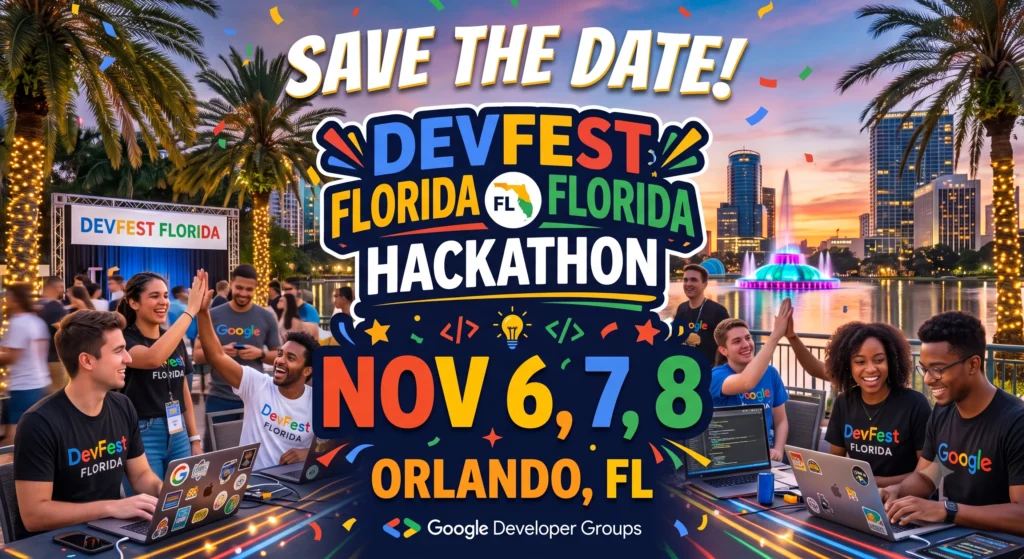
Learn more at DevFestFlorida.com
AI | Mobile | Web | Cloud | Community
DevFest Florida Hackathon is a community-run hackathon experience aimed to bring technologists, developers, students, tech companies, and speakers together in one location to learn, discuss and experiment with technology.
Reserve your spot for the hackathon while space is available. EventBrite
Leave a Reply